


Beyond the finish line: The communication lesson from HYROX Beijing 2026
Written by Stephanie Sicilia
The incident happened in Beijing during a HYROX event on Saturday, 12 September 2026, when Australian elite athlete Joanna Wietrzyk experienced a bowel accident during the race but was still allowed to continue and eventually finished in first place. HYROX later issued an official statement, but instead of calming the discussion, it seemed to create even more questions.
I have been following the HYROX Beijing incident quite closely. I get the hype around HYROX, the energy, the challenge, the community, but one thing I have always wondered about is the hygiene side of it. With so many people using the same equipment and stations one after another, it is something that has genuinely crossed my mind before. I also had a friend competing in Beijing, which made the whole situation feel a lot less distant to me.
So when this happened, the first question that came to my mind was very simple: what would I do if I were one of the participants? Would I comfortably continue racing, especially if I had to use the same station after her?
I have a lot of respect for Joanna for pushing herself to finish the race. That level of determination is probably part of what makes elite athletes elite. But once there is faecal contamination and a possible hygiene risk to other athletes, I think the situation becomes bigger than one athlete wanting to finish.
From what I understand, HYROX is also quite strict when it comes to competition rules. Athletes can be penalised for things like spitting, so naturally it raises the question: why were the officials not expected to stop Joanna, allow her to clean herself up, and then let her continue once it was safe to do so?
For me, this is really where the issue starts.
In a crisis, there is rarely only one stakeholder. There was the athlete, who absolutely deserved dignity and protection from personal attacks. But there were also the other participants, who had legitimate concerns about hygiene, fairness and the risk they were being asked to take by continuing to compete around the same stations.
And then came the official statement.
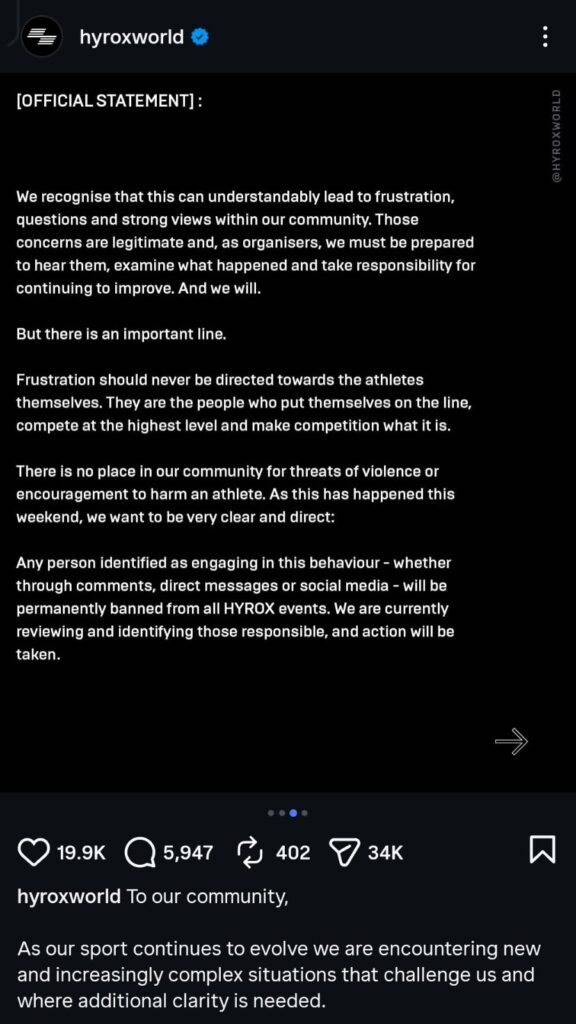
This is probably the part that bothered me the most.
Instead of clearly addressing what happened, why she was allowed to continue and what measures would be put in place if something similar happens again, a significant part of the response focused on online abuse and the possibility that people directing abuse at the athlete could be banned from future HYROX events.
To be clear, I agree that nobody should be harassing her personally. That should never be acceptable.
But these are two separate issues.
You can protect an athlete from being attacked online while at the same time acknowledging that an operational decision may have been wrong.
Before telling the community how they should react, I think the organiser first needed to explain its own actions. What happened on the ground? Why was the athlete allowed to continue? What should officials have done differently? And what happens if the same thing occurs at another event?
Those are legitimate questions.
I also think this is why the statement did not really help to de-escalate the situation. It felt like it was addressing the reaction more than the incident itself.
And when people already feel that the actual issue has not been acknowledged, redirecting the conversation towards how people are responding can actually make the frustration worse.
I know a win is a win. And again, I respect the determination it took for Joanna to finish.
But sport is also about sportsmanship, fairness and consideration for other competitors. At some point, pushing through your own physical limit cannot be the only consideration when other athletes may also be affected by that decision.
And this is probably the bigger communications lesson for brands and event organisers.
When something like this becomes public, empathy and accountability have to come together.
Protect the individual from harassment? Absolutely. But also acknowledge what happened. Explain the operational decision. Tell your stakeholders what should have happened and, more importantly, what you are going to do differently next time.
Because choosing not to directly address the uncomfortable part of an incident rarely makes it go away.
Most of the time, it just gives people more reasons to question why you are avoiding it.